Key Takeaway: To safely clean travertine tile without etching its surface, you must use a pH-neutral cleaner specifically formulated for natural stone or mild dish soap mixed with a minimally damp microfiber mop. Because travertine has a calcium carbonate base, avoiding acidic substances like vinegar, lemon juice, and harsh bathroom descalers is essential to prevent permanent, dull chemical etch marks that cannot be scrubbed away. To maintain a pristine finish, always vacuum or sweep up abrasive grit before mopping, rinse only when directed by the product label, and immediately buff the tile dry to eliminate hard water spots.
To clean travertine tile without etching it, use a pH neutral cleaner made for natural stone, warm water, and a soft microfiber mop or cloth. Keep the moisture minimal, rinse only if the product label calls for it, and dry the surface thoroughly to stop water spots. That's the whole method in one breath.
What you avoid matters just as much. Skip vinegar, lemon or citrus cleaners, acidic bathroom and grout products, and abrasive powders. Travertine is a calcium-based natural stone, and acid reacts with it chemically, leaving dull spots that no scrubbing will lift. If you want to keep your travertine tiles looking the way they did on install day, gentle is the whole game. Here's how to do it right, room by room.
Why Travertine Etches So Easily (and What "Etching" Actually Is)
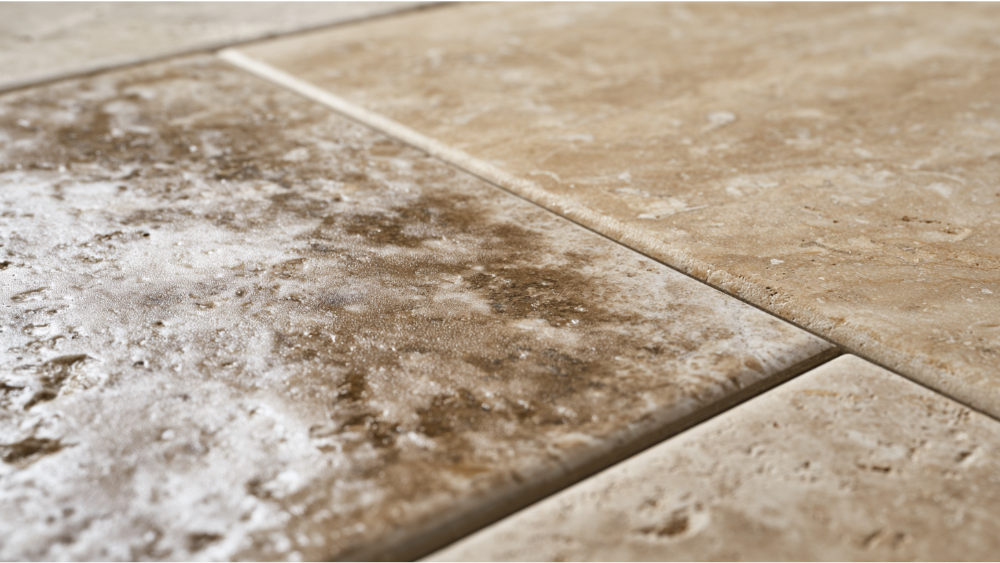
Travertine belongs to the limestone family, which means it has a calcium carbonate base. The Natural Stone Institute notes that limestone and travertine are vulnerable to alteration from even mild acids. That's the reason vinegar, lemon juice, and a lot of everyday bathroom cleaners are risky. When acidic substances touch the stone, they don't just sit on top. They react with the calcium and eat into the surface.
That reaction is what we call etching. And here's the part most people miss: etching is surface damage, not dirt. IICRC describes it as a dull, lighter, sometimes slightly rough mark that appears where acid met the stone. Daltile puts it even plainer, mild acids like lemon juice and vinegar create a mark that is not a removable stain. You can't wipe it away, and cleaning harder won't bring the shine back. This is why so many stains people report on travertine floors turn out not to be stains at all, but permanent etch marks. Minor etching from a single spill can look subtle at first, then stand out once the surrounding stone dries.
A quick word on pH, since it drives every choice in this article. The EPA defines pH on a 0 to 14 scale. Seven is neutral. Anything below 7 is acidic, anything above is alkaline. Travertine wants neutral, which is exactly why a ph neutral cleaner sits at the center of every safe cleaning process for this stone. A simple water test on a hidden spot can tell you whether a mystery product beads or soaks in before you commit it to the whole floor.
One more thing worth knowing before you shop: a label that says "natural," "green," or "citrus" does not mean stone-safe. Citrus is acidic. Read past the marketing and check whether the product is actually made for natural stone surfaces.
What Is the Best Stone Cleaner for Travertine Tile?
The best stone cleaner for travertine is a pH neutral product made specifically for natural stone. It cleans without reacting with the calcium in the stone, and according to Daltile, a neutral cleaner shouldn't affect any sealer already on the surface. For everyday cleaning, the Natural Stone Institute says a small amount of mild dish soap in warm water also works fine.
A light option many homeowners already have on hand is isopropyl alcohol mixed with clean water. It cleans and dries clean without leaving an acidic residue, which makes it handy for quick wipe-downs on both floors and travertine countertops in a kitchen or bathroom.
One honest caution: don't overdo the soap. Too much detergent leaves a film that streaks and actually attracts more dust and dirt. A little goes a long way. If the water looks sudsy, you've used too much. Gentle and consistent beats strong and occasional every time, and it keeps the travertine surface looking even instead of patchy.
Safe Cleaning Products and Supplies for Travertine
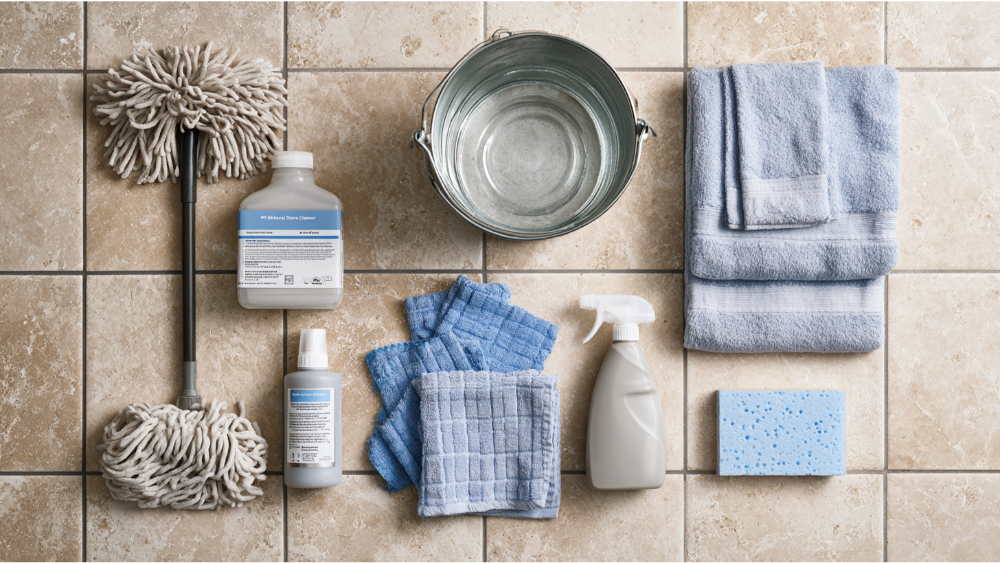
Keep it simple. Here are the cleaning products and tools you actually need:
- A pH neutral cleaner made for natural stone
- Warm water and a separate bucket of clean water for rinsing
- A soft microfiber mop for floors (microfiber won't scratch the tile's surface)
- A microfiber or cotton cloth for drying
- A soft sponge or soft brush for grout lines
- Clean, dry towels
- A putty knife for lifting dried buildup like wax or gum without gouging the stone
- Optional: a stone-safe, non-acidic soap scum remover for showers
- Entry mats and rugs to trap grit before it reaches the stone
That last one does more than it looks. Most surface scratches come from sand and grit being ground underfoot. Catch it at the door and your flooring stays smoother, longer. A soft brush earns its place too, since it lets you work cleaner into grout and textured travertine without dragging anything sharp across a polished face. Having the right tools on hand means you reach for a soft cloth instead of something abrasive when a mess needs attention.
What Not to Use on Travertine Tile
This is where a lot of travertine gets ruined, usually by a well-meaning homeowner reaching for a "hack" they saw online. Here's what to keep away from your stone and why.
| Avoid |
Why |
| Vinegar |
Acidic. Even a light vinegar-and-water mix can etch and eventually damage the stone (Daltile). |
| Lemon and citrus cleaners |
Acidic, despite "natural" labeling. They dull calcium-based stone. |
| Acidic bathroom cleaners |
Formulated for soap scum and hard water, but the acid etches travertine. |
| Acidic grout brighteners |
Run onto the stone face and leave permanent dull marks. |
| Rust and lime removers |
Many contain hydrofluoric acid, which attacks stone (NSI). |
| Bleach as a routine cleaner |
Too harsh for regular cleaning on natural stone. |
| Scouring powders and cream cleansers |
Abrasive, they scratch the surface. |
| Steel wool and stiff scouring pads |
Scratch polished faces. |
| Soaking-wet mops |
Excess moisture can work into the porous stone over time. |
| Steam mops and a steam cleaner |
Skip them unless your installer or the manufacturer explicitly approves. |
Safety callout: never mix ammonia and bleach. The combination creates a toxic gas that can be lethal (NSI). Homeowners sometimes combine cleaners while fighting shower buildup, which is exactly when this goes wrong. Open windows and run a fan whenever you use any strong cleaner in a small bathroom.
We'll be straight with you: there's no shortcut here. The vinegar trick you saw might work great on ceramic tile, but on travertine it's a slow way to wreck a surface you paid good money for. The same caution applies to other soft stone surfaces you may have around the house.
How to Clean Travertine Floors: The Step by Step Process
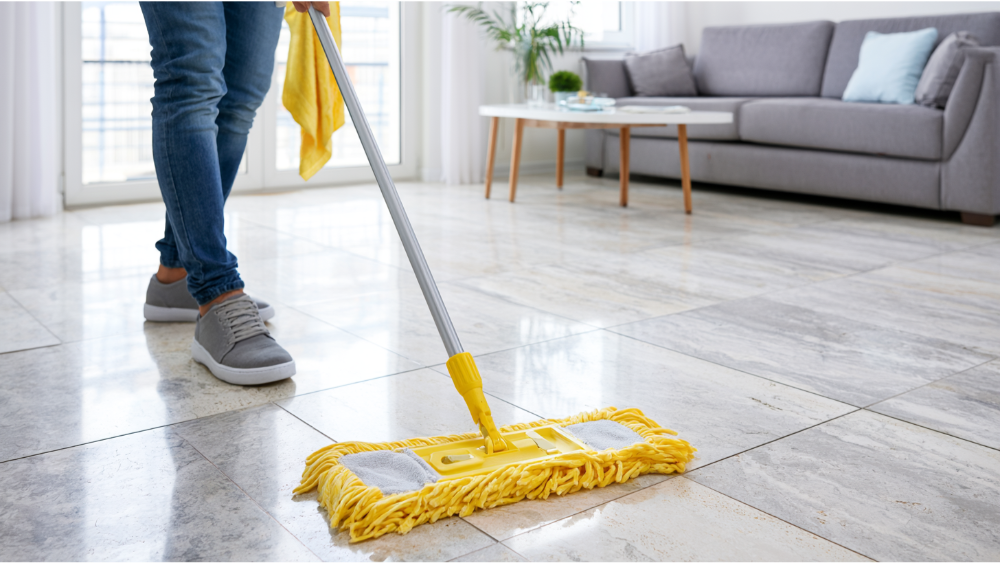
A weekly clean keeps buildup from ever becoming a problem. Here's the routine that protects the stone.
- Remove loose debris first. Dry mop or run a vacuum cleaner on a soft or hard-floor setting to remove loose debris before you add any moisture. Grit is what scratches, so lifting fine particles and loose debris matters more than people expect. A dust mop is gentle enough to remove dust daily without dragging anything sharp across the stone.
- Mix your cleaner per the label. If you're using a no-rinse neutral cleaner, IICRC suggests roughly 1 ounce per gallon of warm water. Don't eyeball extra "for good measure."
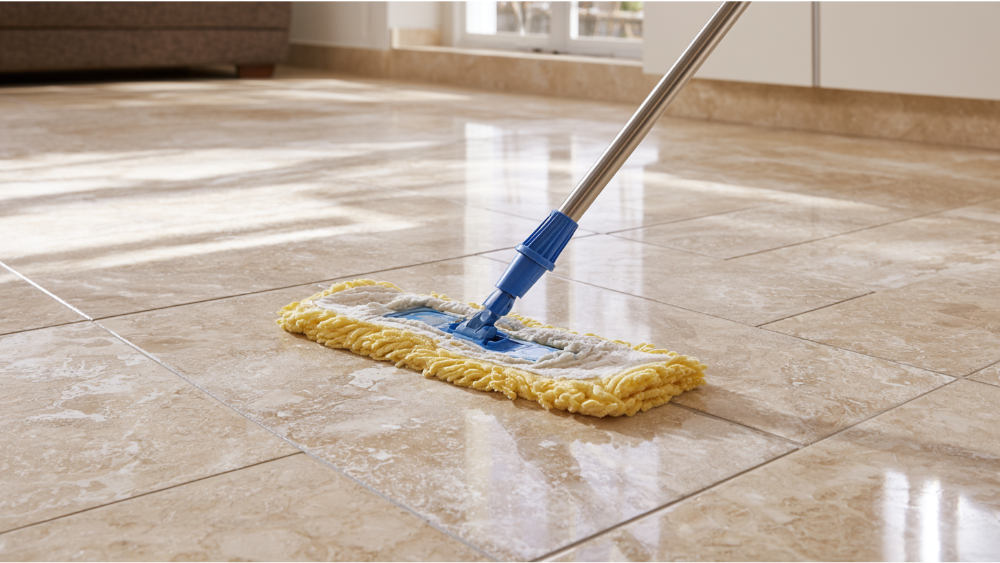
- Use a damp, not soaking, microfiber mop. Wring the mop out well. The surface should look barely wet, then dry within a minute or two.
- Work in small sections. IICRC recommends areas around 10 by 10 feet, smaller if the floor is heavily soiled. It keeps you from spreading dirty water across clean stone.
- Change your solution frequently. Daltile advises swapping out the cleaning water every 100 square feet so you're not reintroducing dirt you just picked up.
- Buff dry. Go over the surface with a soft microfiber cloth to prevent water spots. This step is the difference between a clean floor and a spotty one.
Keep repeating "damp, not wet" in your head the whole time. Travertine floors and standing water are not friends, and a soaked mop is the fastest way to drive moisture into stone you're trying to protect. High traffic areas like hallways and kitchen paths need this routine more often than the corners nobody walks through.
How to Clean Travertine Shower Tile Without Damaging It
Showers are where travertine takes the most abuse: constant moisture, soap, and the temptation to reach for aggressive cleaners. The simplest habit that helps most is a squeegee after every shower. The Natural Stone Institute recommends it, and it cuts soap scum before it ever builds up.
For actual scum, use a stone-safe, non-acidic soap scum remover. Never vinegar, never a CLR-style hard-water product. For stubborn stains and buildup, NSI allows a limited-use mix of about half a cup of ammonia to one gallon of water, but treat this as an occasional fix, not your everyday cleaner. Frequent ammonia use can dull the stone, and it must never be combined with bleach. A little elbow grease with a soft brush lifts more than a harsh chemical ever should.
Dry the surfaces you can reach with a cotton cloth. And take a second to figure out what you're actually looking at. Cloudy buildup could be a mineral deposit, soap film, a failing sealer, or etching. Cleaning fixes the first two. It won't touch the last two. If a dull area doesn't wipe away no matter what you try, you're likely past cleaning and into repair territory, and pushing harder risks further damage.
How to Clean Grout Between Travertine Tiles
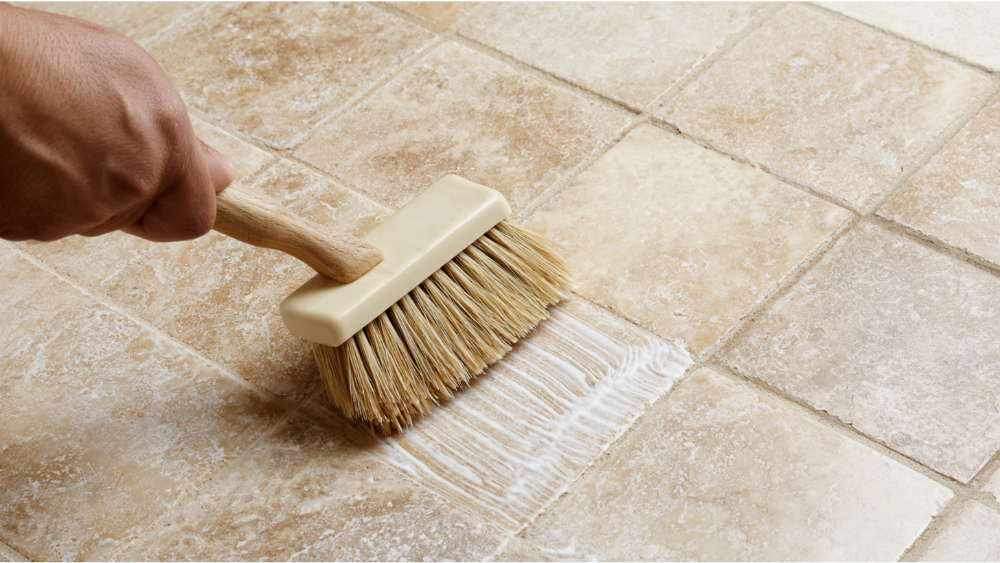
Use the same pH neutral stone cleaner and a soft brush along the grout lines. Work the cleaner in gently, then wipe and dry. A soft brush lets you reach into the recesses without scratching the travertine surface on either side of the joint. A dab of hydrogen peroxide on a stubborn grout spot is milder than bleach, but test it first and keep it off the stone face.
Stay away from acidic grout brighteners. Even if the product is aimed at the grout, the runoff lands on the travertine face and etches it. That's a common way people damage stone while trying to make it look better. Wipe up any residue left behind so it doesn't dry into a film.
Baking soda deserves a caution too. It's mildly abrasive and alkaline, so don't scrub it across a polished travertine surface. If you use any new method on grout, test it in a hidden spot first. Better to learn on a corner nobody sees than on the middle of your shower floor. A fresh grout sealer along the joints once the lines are clean helps them resist staining between deep cleans.
Is It Dirt, Stain, Soap Scum, or Etching?
Before you attack a mark, figure out what it is. The fix depends entirely on the cause, and using the wrong one can make things worse. Spills that sit too long are usually behind the marks people struggle with, so knowing the difference saves a lot of wasted scrubbing.
| What you see |
What it likely is |
What actually helps |
| General grime or film that comes off with wiping |
Dirt or film |
pH neutral stone cleaner and a soft cloth |
| Cloudy, filmy buildup in a shower |
Soap scum |
Non-acidic, stone-safe soap scum remover |
| A darker spot that looks absorbed into the stone |
Stain |
A stone-safe poultice may lift it (older stains may not fully clear) |
| A dull, lighter, sometimes rough spot that won't wipe away |
Etch |
Surface damage. Cleaning won't fix it; it needs refinishing or polishing powder. |
We'd rather tell you the truth than sell you false hope: if the mark is etching, no cleaner on earth will reverse it. Knowing that up front saves you from scrubbing a spot that only gets worse the harder you go at it. Real stains from spills like wine or coffee can sometimes be drawn out with a poultice, but etching is a different problem entirely.
What to Do if Your Travertine Is Already Etched
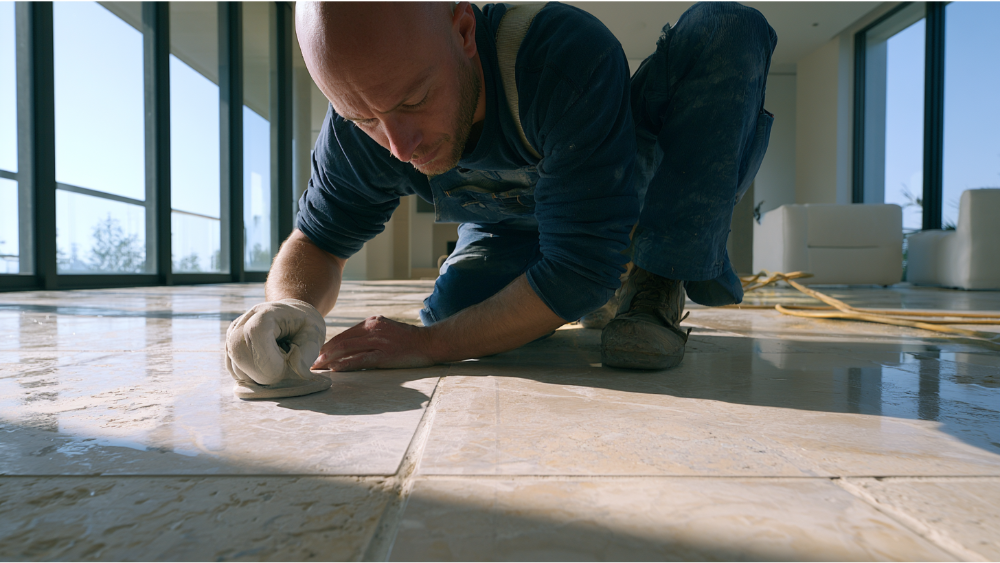
We understand how frustrating it can be to find a dull mark on stone you took care of. So let's talk about what actually helps.
Stop using harsh chemicals and acidic cleaners right away, even if you think they might "clean up" the spot. Switch to gentle, pH neutral cleaning only. And stop scrubbing. Scrubbing won't reverse an etch, and abrasive effort can spread the damage across a wider patch of the surface.
Light etches can often be refinished with a fine polishing powder or repolished by a professional cleaner or stone restorer. Deeper damage may call for repair or replacing the affected tile. Which route makes sense depends on how deep the etch goes and where it sits. An etch in the middle of a shower floor is a different job than one on the edge of a rarely-touched countertop.
If it comes to repair, replacement, or rethinking the space entirely, Kibuk Tile And Construction handles tile repair, tile replacement, and bathroom remodeling for homeowners across Vancouver, WA and Portland, OR. We work with budgets of all sizes and never cut corners to get there, and we're always upfront and transparent about what a job actually needs. Our Oregon CCB license number is 234414. When you're ready, a free estimate is the easiest place to start.
Sealing and Re Sealing Travertine: Does It Stop Etching?
Yes, sealing helps. Most stone sealers are impregnators that work like repellents. They make travertine more resistant to staining and moisture, and a sealed surface cleans more easily and dries more evenly. That resistance buys you a little time to wipe up spills before they soak in. NSI is clear that these products make stone stain-resistant, not stain-proof, so treat sealing as protection, not a force field.
No, sealing does not stop etching. This is the big misconception in a lot of cleaning advice online. Acid can still chemically react with the calcium in the stone through a sealer. Sealing buys you time against spills and stains; it does nothing against a splash of vinegar or lemon juice.
How often should you handle re sealing? Roughly every one to two years is a common range, but the honest answer is to follow your sealer manufacturer's guidance. Sealers wear off with use and exposure, so a busy shower floor or a well-used kitchen countertop needs it sooner than a low-traffic entryway. The same principle applies to other natural stone surfaces in the home, including granite and marble countertops.
A Simple Daily Maintenance Routine for Travertine
Pull it all together into a rhythm you'll actually keep. Regular cleaning in small doses beats a rare all-day scrub every time.
- Daily: dry mop or quickly vacuum high-traffic floors to lift grit and remove debris. Squeegee shower walls after use.
- As it happens: wipe up spills immediately, especially acidic ones like wine, juice, coffee, or tomato. Speed matters here, since acid can start etching almost instantly, and a fast wipe helps prevent staining before it sets.
- Weekly: clean travertine floors with a pH neutral cleaner and a damp microfiber mop, then buff dry.
- Every one to two years: reseal per your product's guidance to keep the surface protected.
- Always: keep mats at entrances to trap dirt before it reaches the stone.
A few small habits protect the look and the durability of the tile far better than an occasional deep cleaning session with harsh products. Consistency is the quiet secret to stone that still looks good years from now, and it makes effective cleaning something you barely think about instead of a chore you dread.
A Quick Note for Portland and Vancouver Homeowners
If you're cleaning travertine in the Portland or Vancouver area and notice water spots, your local water source may play a part. The Portland Water Bureau reports that Bull Run water, the city's main supply, is soft at about 7 to 11 ppm, roughly half a grain per gallon. Portland groundwater runs moderately hard at around 80 ppm, about 5 grains per gallon. Harder water leaves more mineral spotting on stone surfaces, which is one more reason to dry the travertine floor tiles after cleaning. It's a small detail, but it explains why two homes can see different amounts of buildup on the same tile.
When Cleaning Isn't Enough
Cleaning travertine well comes down to respecting what it is: a beautiful calcium-based stone that stays gorgeous with gentle, pH neutral care and dries clean. Skip the acids, skip the abrasives, and dry it off. That protects both the look and the long-term value of your tile.
But if your travertine is already etched, cracked, loose, or part of a bathroom you've been meaning to update, cleaning can only take you so far. That's where we come in. Kibuk Tile And Construction offers quick, reliable and professional work for homeowners across Vancouver, WA and Portland, OR, with no job too big or small. So, what are you waiting for? Call us today at
(360) 608-4629 for a free estimate.



Comments